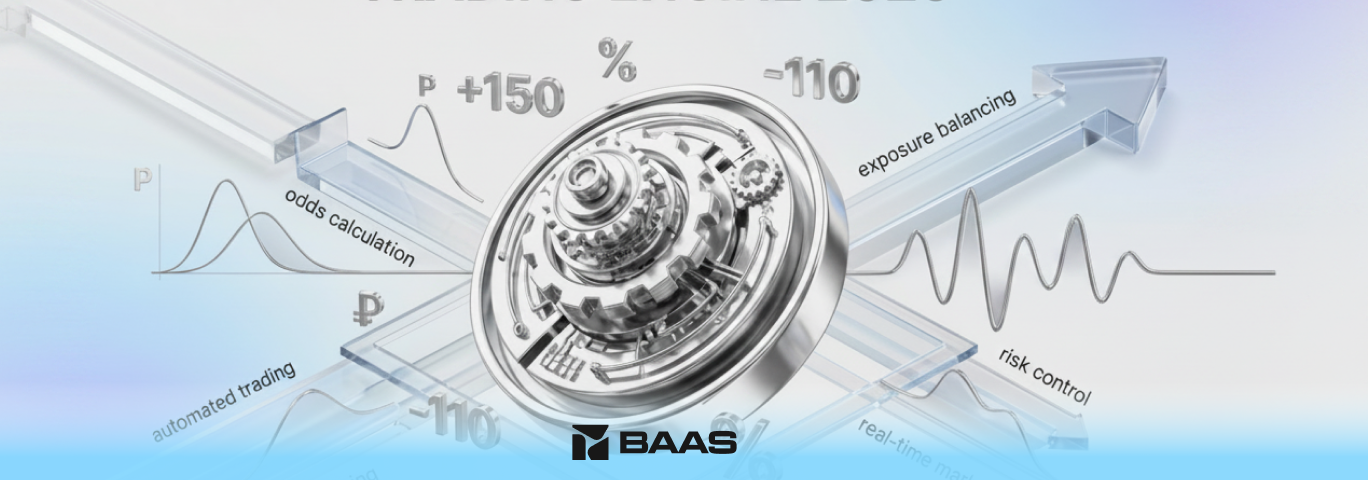
Behind every online sportsbook sits a complex technology stack that handles thousands of events, millions of odds updates, and real-time risk calculations – often simultaneously. For operators entering the market or evaluating a platform switch, understanding how sportsbook software actually works is not optional; it is the foundation of every commercial decision that follows.
This article breaks down the core components of modern sportsbook software, explains how they interact, and highlights what separates a competent platform from a market-leading one.
Sportsbook software is the engine that powers an online betting operation. It is not a single application but rather a system of interconnected modules, each responsible for a distinct function: generating odds, accepting bets, managing risk, processing payments, running promotions and ensuring regulatory compliance.
Think of it as an operating system for a betting business. The front-end (the website or mobile app that players see) is only the surface layer. Underneath it are the trading engine, risk management tools, player account management (PAM), content management system (CMS), payment orchestration and reporting dashboards. Each module must work in real time, because a one-second delay in odds updates or bet acceptance can mean the difference between profit and loss.
The odds engine is the heart of any sportsbook. It receives raw probability data from one or more odds feed providers (companies such as Genius Sports (formerly Betgenius), Sportradar, LSports, or proprietary trading desks) and converts those probabilities into customer-facing odds with margins applied.
The process works in stages. First, the feed provider delivers pre-match and in-play odds based on statistical models, historical data and real-time event information. The sportsbook platform then applies the operator's margin preferences (for example, a 5% overround on football match results and 7% on corner markets). Finally, the adjusted odds are published to the front-end and made available for betting.
Sophisticated platforms allow operators to customise margins per sport, league, market type and even individual events. This granularity is critical: a blanket 6% margin across all markets leaves money on the table on high-volume events and exposes the operator to risk in low-liquidity markets.
The trading module is where odds management meets commercial strategy. It sits between the raw feed and the customer-facing line, giving the operator (or automated rules) control over what is offered and at what prices.
Pre-match trading typically involves reviewing opening odds from the feed, applying operator-specific adjustments (based on local market knowledge, liability exposure, or promotional requirements), setting maximum stake limits per market, and suspending or removing markets when information is incomplete.
Live (in-play) trading is significantly more complex. Odds are updated every few seconds, sometimes multiple times per second during fast-moving events such as tennis or basketball. The trading module must handle automatic suspension during key moments (goals, red cards, break points), rapid odds recalculation based on score changes and time elapsed, manual trader overrides when the automated model lags behind real-world events, and bet acceptance delays (typically 5 to 15 seconds) to protect against latency exploitation.
The best trading modules blend automation with human oversight. Fully automated trading scales efficiently, but misses context that an experienced trader would catch. Fully manual trading offers precision but cannot keep pace with a live schedule of 50,000+ events per month.
Risk management is the module that keeps a sportsbook profitable. Its job is to ensure that the operator's exposure to any single outcome, event, or player remains within acceptable limits.
Key functions include real-time liability monitoring, which tracks how much the sportsbook stands to pay out for each possible result across all markets on an event. When liability on one outcome crosses a threshold, the system can automatically shorten odds, reduce maximum stakes or alert a trader.
Player profiling categorizes bettors based on their behavior: recreational players, sharp bettors (consistently profitable), bonus abusers, arbitrage players. Each category can trigger different rules. For example, sharp accounts may receive lower limits, while suspicious patterns may require enhanced verification.
Automated alerts flag unusual activity: a sudden spike in stakes on a low-profile event, a cluster of maximum-stake bets from linked accounts, or odds movement that diverges from the broader market. These signals may indicate informed betting, match manipulation or simply a data error, but all require attention.
Multi-event exposure analysis calculates cumulative risk across accumulators and system bets, where a single outcome can appear in thousands of bet slips simultaneously.
Modern risk management is largely algorithmic, but the best platforms provide a trader dashboard with visual tools (heatmaps of liability, real-time P&L by event, configurable alert thresholds) so that human judgment can intervene when the models reach their limits.
PAM handles everything related to the player lifecycle: registration, identity verification (KYC/AML), deposit and withdrawal processing, bonus management, responsible gambling tools and account communication.
For operators, the quality of PAM directly affects conversion (how many visitors become depositing customers), retention (how long they stay active) and compliance (whether the operator meets regulatory obligations).
A strong PAM module supports multiple registration flows (email, phone, social login, single sign-on), integrates with third-party KYC providers for automated identity verification, manages a unified wallet across sportsbook, casino, and other verticals, offers a flexible bonus engine (free bets, deposit matches, cashback, accumulator boosts) with configurable wagering requirements, and includes responsible gambling features such as deposit limits, loss limits, session time limits and self-exclusion.
Payment processing in iGaming is not a simple gateway integration. Operators must support multiple payment methods across multiple jurisdictions, each with its own regulatory requirements, processing times, and failure rates.
A sportsbook platform typically integrates with a payment orchestration layer that routes transactions to the optimal provider based on geography, currency, payment method, and success rate. Key methods include bank cards, e-wallets, bank transfers, mobile payments and, in some markets, cryptocurrency.
Critical metrics for operators include deposit success rate (the percentage of attempted deposits that actually complete), time to withdrawal (how quickly players receive their winnings) and cost per transaction (processing fees that eat into margin).
When a player places a bet, the following happens in a matter of milliseconds. The front-end sends the bet request (selection, stake, odds) to the back end. The trading module checks whether the odds are still valid and whether the market is open. The risk management module evaluates the bet against the player's profile, current liability and configured limits. If approved, the PAM deducts the stake from the player's balance. The bet is recorded and the liability is updated across all affected markets. For live bets, an additional acceptance delay may be applied to protect against latency.
When the event concludes, the system receives the official results, settles all bets automatically, credits winnings to player accounts and updates the operator's P&L in real time.
This entire cycle – from bet placement to settlement – must be reliable at scale. A platform serving a mid-size operator might process 100,000 bets per day across 30,000 markets. Tier-one platforms handle millions.
Not all sportsbook platforms are created equal. When evaluating software, operators should consider several key factors.
Odds quality and coverage: How many sports, leagues and markets are available? Is the in-play offering deep, or limited to major events? Can the operator customize margins by sport and market type?
Trading flexibility: Can the operator adjust odds manually? Are there automated trading rules? How fast is the live odds update cycle?
Risk management depth: Does the platform offer player profiling, automated alerts, liability visualization and multi-event exposure analysis? Or is risk management limited to basic stake limits?
Integration ecosystem: How many payment providers, KYC services, data feeds and front-end frameworks are supported? Is the API well-documented and maintained?
Scalability and reliability: What is the platform's uptime track record? Can it handle traffic spikes during major events (the World Cup final, the Super Bowl, or Champions League nights)?
Regulatory compliance: Does the platform support the licensing jurisdictions the operator needs? Are responsible gambling tools built in, or bolted on?
Sportsbook software is the invisible infrastructure that determines whether an operator can compete. Understanding how it works – from odds generation to risk management to settlement – is the first step toward making an informed platform decision.




.svg)





.svg)